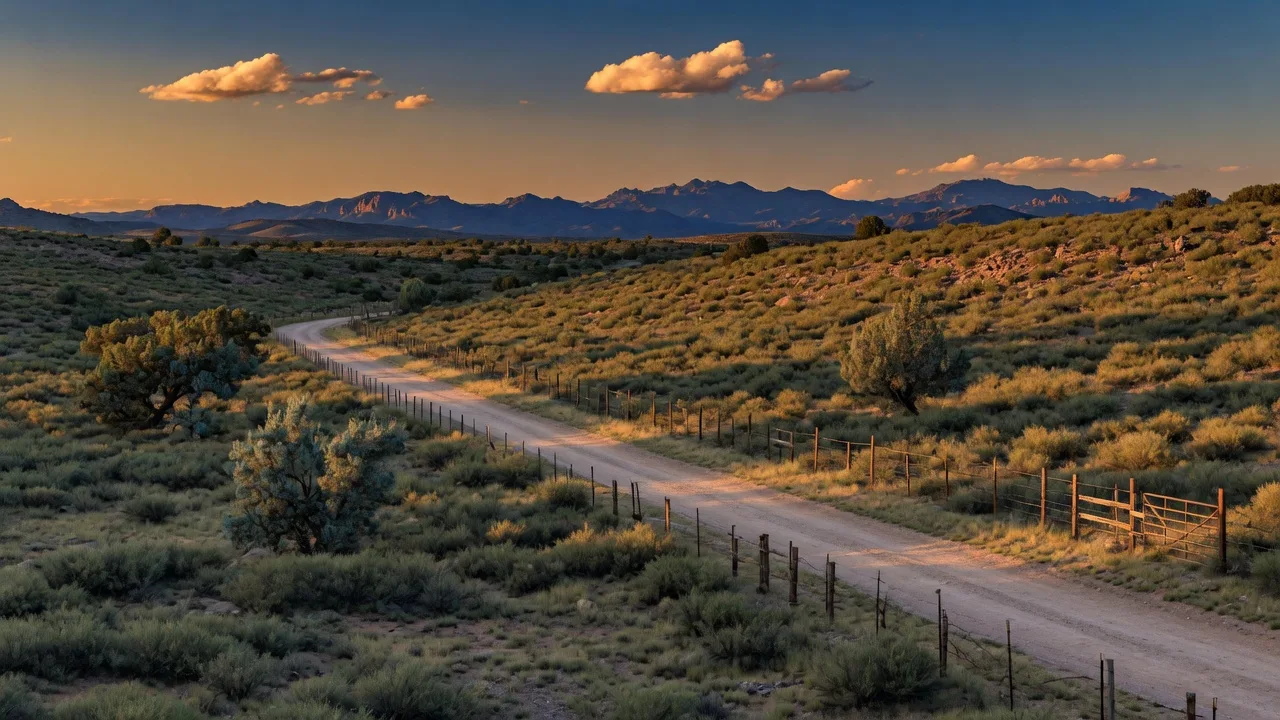
The zoning district on a Gila County parcel decides what you can legally do with the land, and it's the first thing I check before I ever talk price. Zoning is what tells you whether you can run animals, build a shop, park an RV, add a second dwelling, or open a small business on the property you're about to buy. After nearly a decade of selling off-grid land, rural homesteads, and unconventional properties across Gila County, I've watched buyers fall for a parcel, then discover the zoning doesn't match their plan. Here's what the districts actually mean on the ground, so you can check the right things before you make an offer.
Zoning facts in this guide come from the Gila County Zoning Ordinance for Unincorporated Areas (revised March 15, 2022) and the Gila County Assessor.
THE DISTRICTS THAT ACTUALLY EXIST IN GILA COUNTY
Unincorporated Gila County is zoned under one countywide ordinance, and the districts are laid out in the code: R1 and R1L for single-family residential, MHS for manufactured-home subdivisions, and the rural districts where most off-grid buyers actually land, RR (Rural Residential), GR (General Rural), SFR (Single Family Rural), and SR (Suburban Ranch). Multi-family and transitional districts (R2, R3, R4, TR) cover denser pockets, and C1 and C2 handle commercial use along the highway corridors like AZ 60 and 77.
Here's the part that surprises most buyers: there is no standalone agricultural zoning district in Gila County. Farming and ranching are permitted uses within the rural districts, which is exactly what you want when you're shopping for acreage to run animals or build a homestead. The district on the parcel, not a label in a listing, is what controls minimum lot size, setbacks, and what uses are allowed.
RR
Rural Residential
Where many off-grid buyers end up
GR
General Rural
Farm and ranch uses on larger parcels
SFR
Single Family Rural
Rural homesites with room to spread
SR
Suburban Ranch
Ranch living closer to town
MHS
Mobile Home Subdivision
Manufactured-home communities
C1 / C2
Commercial One / Two
Highway commercial along AZ 60 and 77
WHY "CB-1" SHOWS UP ON LISTINGS, AND WHY TO VERIFY IT
You'll see "CB-1" on land listings and marketing copy around Arizona, and it's worth knowing the truth: CB-1 is not a Gila County zoning district. The county's commercial districts are C1 and C2. When a listing cites a designation that isn't in the county ordinance, that's a flag to pull the parcel's official zoning map record before you rely on anything the listing claims.
This is the kind of conflicting data I flag every week. A zoning line costs nothing to paste into a listing, but it can be wrong, stale, or pulled from another jurisdiction entirely. On rural properties especially, I've seen acreage, square footage, and even zoning designations disagree across sources. The county's official zoning map is the authority, and that's where I start on every property I work with.
"A listing's zoning line costs nothing to paste in. It can still be wrong. The county zoning map is where the truth lives, and it's the first place I look."
WHAT "NO HOA" REALLY MEANS FOR ZONING
Most of the buyers I work with say the same thing: I don't want an HOA telling me what to do with my own land. I get it, and most rural Gila County acreage has no homeowners association at all. But no HOA does not mean no rules. An HOA is a private set of covenants; zoning is county land use law. They're separate things, and you can have no HOA and still be bound by a zoning district that limits what you can build or run.
So when you see "no HOA" on a listing, read it as what it is: freedom from a homeowners association, not freedom from county land use rules. The parcel's district, access, and water story are the real limits, and they're all checkable before you commit.
AGRICULTURAL CLASSIFICATION IS A TAX STATUS, NOT ZONING
Sellers and buyers mix these up all the time, and it matters. Agricultural classification is a property tax program run by the Gila County Assessor, not a zoning or land use approval. Land that qualifies is taxed on its agricultural value rather than its market value, which can make a real difference in carrying costs. The county generally requires the land to be put to an eligible agricultural, mining, or grazing use, with minimum acreage and income requirements that vary by use, and applications are accepted January 1 through September 30 each year.
Here's the catch that surprises people. Agricultural classification can lower your tax bill, but it does not change what the land is zoned for, and it does not give you permission to run animals or build a shop. Zoning and tax status are two separate files on the same parcel, and I've seen sellers anchor their asking price to an assessed value that reflects ag status while the market value tells a different story. Knowing which number means what is half the battle on rural property.
WHAT TO CHECK BEFORE YOU MAKE AN OFFER
Three things to verify on any Gila County parcel before you write an offer. First, is it private land? Roughly 95% of the county is federal land, including the Tonto National Forest and the San Carlos Apache Reservation, and much of Tonto Basin and the Highway 77 corridor sits on it. Make sure the parcel you're buying is private, county-zoned land with a legal lot. Second, what does the official zoning map say? The Gila County Planning and Zoning Division, with offices in Globe at 745 N Rose Mofford Way and in Payson, is the authority on the district and what it allows. Third, does the land have legal access and a legal lot, and where do the well and septic sit relative to setbacks?
That last part is where a local agent earns their keep. I know this county's roads, districts, and quirks, so I can tell you whether a specific parcel's zoning matches your plan before you spend a dime on due diligence. Want to see how this plays out on real inventory? Every property on my current listings page comes with the zoning, water, and access story verified, not just a listing sheet repeated back at you.
THE BOTTOM LINE
Zoning decides whether the property you're dreaming about is actually buildable, usable, and legal for what you want to do. It costs you nothing to check and everything to skip. Read the district, verify it against the county map, and sort out the difference between zoning, an HOA, and a tax classification, and you'll avoid the single most common regret I see from buyers who move too fast on rural land.
If you want to know what a specific parcel in Gila County is zoned for and whether it matches your plans, call or text me at 480-797-1824. I'll pull the zoning, water, and access story with you so you can make an offer with your eyes open.

Written by Neil Blindauer

Realtor, DeLex Realty · A.I. Certified Agent™
With 9 years in real estate, I specialize in off-grid land, rural homesteads, and one-of-a-kind properties across Gila County, serving Globe, Miami, Winkelman and Kearny.
Learn more about Neil