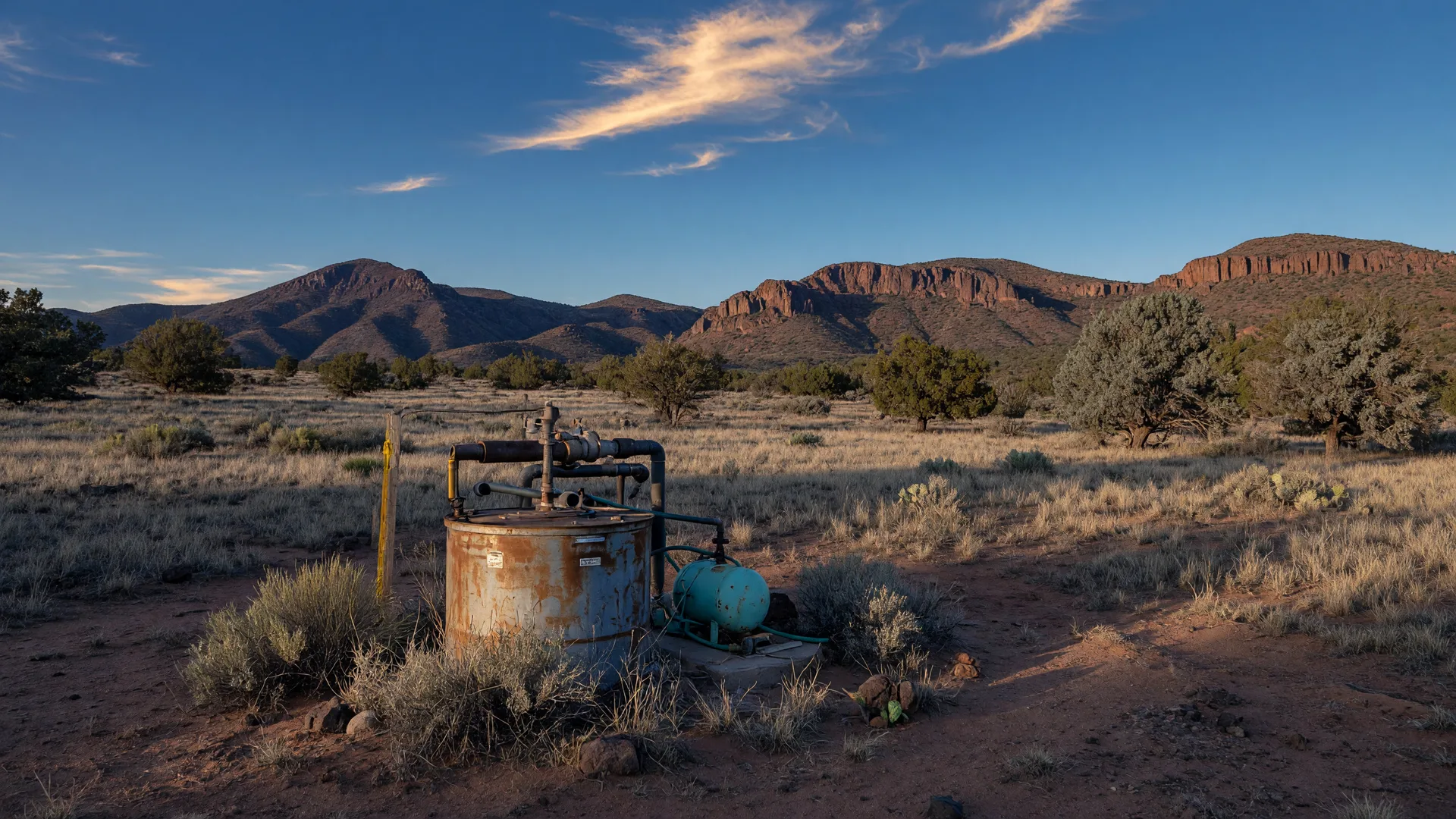
Can you even get water out there? It's the first question every off-grid buyer asks me, and the honest answer is: almost always yes, but you have to verify it before you make an offer. Water access on rural Gila County land comes down to four checkable things: whether the parcel is private land, what the neighboring wells produce, what the county and state actually require, and what the well records say about depth, yield, and quality. Here's exactly how I check each one, and how you can too.
Water and well facts in this guide come from the Arizona Department of Water Resources, the Gila County Wastewater Division, and the University of Arizona Cooperative Extension's Well Owners' Guide to Ground Water Resources in Gila County.
THE SHORT ANSWER: YES, BUT VERIFY
Gila County sits entirely outside Arizona's five Active Management Areas, which is genuinely good news for a buyer. A domestic well here does not need an ADWR well permit, and there are no AMA pumping restrictions to worry about. What you do need is a registered well. All water wells in Arizona must be registered with the Arizona Department of Water Resources, and before drilling, the owner files a Notice of Intent to Drill. For a domestic well pumping 35 gallons per minute or less, that's the whole state-level process: registration, not permission.
Groundwater supplies roughly 94% of the water used in Gila County, so the water is here. But this is mountain country. Wells are drilled into hard volcanic and crystalline rock, where water lives in fractures and faults, and yields can run under 5 to 10 gallons per minute and vary a lot from one parcel to the next. That variability is exactly why you check before you commit.
STEP ONE: CONFIRM THE PARCEL IS PRIVATE LAND
Before you ask whether a parcel has water, ask whether it's private land at all. Only about 4% of Gila County is privately owned. Roughly 57% is federal land, 38% is tribal land, and about 1% is state land, and much of Tonto Basin and the Highway 77 corridor sits on federal ground. A well story only means something on a private, legal lot you can actually buy. This is the first thing I verify on every property I work with, and it's the first thing you should ask your agent to show you on a map.
STEP TWO: READ THE NEIGHBORS' WELL RECORDS
The single best predictor of what a parcel's well will do is what the wells on the parcels around it already do. Well records are filed with ADWR and they're public. The agency's Depth to Water dashboard shows basin-level groundwater data, and well records show depth and yield for nearby wells. Those records, reported to ADWR, show Gila County wells averaging around 385 feet deep, with the average near Globe closer to 350 feet. Drilling commonly runs $30 to $70 per foot, so a completed domestic well can land anywhere from $10,000 to $45,000 or more depending on depth and geology.
None of that is a reason to walk away. It's a reason to price the property with your eyes open. A parcel with a proven, producing well next door is worth more than one where nobody has ever drilled, and the records will tell you which situation you're in.
STEP THREE: KNOW WHAT THE COUNTY AND STATE ACTUALLY REQUIRE
Here's the process in plain terms. All water wells in Arizona must be registered with ADWR. Before drilling, deepening, or replacing a well, the owner files a Notice of Intent to Drill, Form 55-40 for wells outside the Active Management Areas. In Gila County, the county's Wastewater Division reviews the site plan, including the 50-foot setback from sewage disposal systems, before ADWR issues the drilling card to the licensed well driller. The well is then registered in the owner's name, and that registration stays with the property.
The takeaway: there's no mystery here and no reason to be scared of the paperwork. It's a straightforward registration process, and it's one of the things I walk buyers through on every off-grid transaction.
STEP FOUR: TEST THE WATER, NOT JUST THE WELL
A well that flows isn't the same as water you want to drink. Water quality across Gila County is generally good, but this is mining country, and there are cleanup sites tied to the mining history near Globe and Miami. That means a water quality test matters, and so do the well log and a flow test. When I'm working a property, the due diligence list includes the well log, a flow test, a water quality test, the well-to-septic setback, and access for the drilling rig if the well ever needs service.
"A well that flows is not the same as water you can count on. The neighbor's well records, a flow test, and a water quality test tell you what the listing photo can't."
WHAT THIS MEANS FOR YOUR OFFER
Concrete numbers are the whole game. When a listing can show you a private well with a real flow rate, that's a property with a verified water story, and it should be priced and presented that way. My featured listing at 6368 N AZ Highway 288 in Globe, for example, comes with a private well rated up to 500 gallons per minute, and that kind of detail is exactly what separates a serious off-grid property from a question mark. You'll find that listing on my current listings page, and every property I represent comes with the water, zoning, and access story verified, not just a listing sheet repeated back at you.
THE BOTTOM LINE
Water access on rural Gila County land is checkable before you ever write an offer. Confirm the parcel is private, read the neighboring well records, understand the registration process, and test the water itself. Do those four things and you take the biggest gamble out of off-grid buying.
This is the work I do every week, and it's why I'm based in Globe rather than Phoenix: I know the roads, the wells, and the quirks of this county's water story. If you're looking at a parcel and wondering whether the water works, call or text me at 480-797-1824, or send a message through the contact page. I'll pull the well records and the parcel details with you so you can make an offer with your eyes open.

Written by Neil Blindauer

Realtor, DeLex Realty · A.I. Certified Agent™
With 9 years in real estate, I specialize in off-grid land, rural homesteads, and one-of-a-kind properties across Gila County, serving Globe, Miami, Winkelman and Kearny.
Learn more about Neil