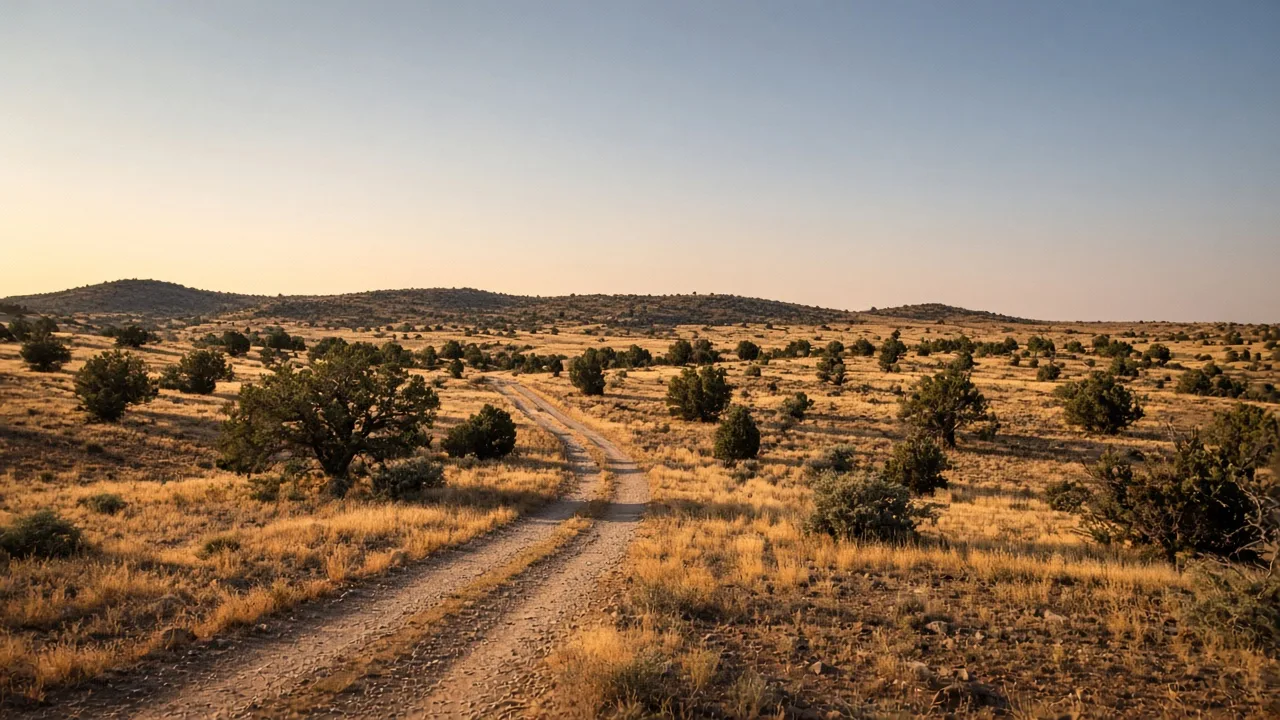
In Gila County, a parcel has legal access in only two ways: frontage on a public street, federal, state, or county road, or a recorded private ingress and egress easement that connects to one of those. That is the whole test, straight from the county's Minor Land Division Ordinance, and it is the single question most rural buyers never think to ask before they fall for the price on a remote parcel. Years of driving in on a worn two-track is not legal access, and if that road is not public and not recorded to the parcel, a title company will not insure you onto the property, a building permit will not issue, and your only remedy is a court-ordered private way of necessity under Arizona law. Here is what to check before you offer, and why the cheap landlocked parcel is rarely the deal it looks like.
Access rules in this guide come from Gila County's Minor Land Division Ordinance, the county's Roadway Design Manual, and Arizona Revised Statutes Section 12-1202, the private way of necessity statute. This is general information for buyers and sellers, not legal advice, and every parcel is different. Have a title professional confirm the access story on the specific property you are considering before you commit.
WHAT COUNTS AS LEGAL ACCESS IN GILA COUNTY
The county defines it plainly. Legal access means a way of approach to physically enter the property, and it has to be one of two things: the parcel fronts a public street or road, or it carries a recorded private easement for ingress and egress that connects to a public road. There is no third option. That means the gravel county lane you drove in on counts only if it is genuinely a public road maintained or adopted by the county, or if the private easement granting you the right to use it is recorded against the land and connects to something public. This is a different and stricter test than the one a buyer naturally uses, which is "did my truck get here." A truck can get there for decades on a road that gives you no legal right to be there, no insurable title, and no permit.
THE CHECK THAT MATTERS MOST: SCHEDULE B ON THE TITLE REPORT
Before you offer on any rural parcel, get a preliminary title report and read the exceptions section, the part often called Schedule B. It is the single most important document in the whole deal, and it is where a missing access problem shows up. Look for two things. First, that a recorded ingress-egress easement or right of way exists, is appurtenant to the parcel you are buying, and connects to a public road. Second, the exceptions the title company lists. A truly landlocked parcel will almost always draw an explicit title exception stating the public records show no means of ingress and egress, and title companies will not insure access on a parcel like that. If you see that exception, you are not buying a hidden bargain. You are buying a lawsuit, unless a recorded easement can be secured before closing.
PUBLIC ROAD, PRIVATE ROAD, OR JUST PERMISSIVE USE
Once you know you are on a private road, the next question is whether the easement is actually recorded to your parcel. There is a meaningful difference between a right you can insure and a habit. If a neighbor or a prior owner simply let people drive across the land, that is permissive use, and in Arizona it is usually treated as uninsurable access, not a right that transfers with the sale. Years of driving in without an easement does not become legal access by repetition; it can even amount to trespass until it is formalized. For newly divided parcels outside a subdivision, Gila County requires the ingress-egress easement to be at least 24 feet wide, and it must be recorded. So when you are looking at a listing on remote acreage, ask for the recorded easement by name and number, not a verbal assurance that "the neighbors have always shared the road."
WHEN A PARCEL IS LANDLOCKED: THE PRIVATE WAY OF NECESSITY
Here is the reality for a parcel with no recorded, insurable access: it is landlocked, and in Arizona the fix is a private way of necessity under A.R.S. Section 12-1202. The law lets an owner whose land is situated so that access is necessary for its proper use and enjoyment obtain a way of necessity over a neighboring owner's land. But read that carefully, because it is a court action, not an automatic right. You file suit, a judge decides whether necessity exists on the facts of your parcel, and you usually have to pay the neighboring landowner for the right of way the court grants. That is time, legal fees, and uncertainty, and it can run into real money before you ever build anything. In my experience this is exactly the kind of complication a buyer does not want to discover after closing, because by then the leverage is gone and the only path is litigation. A recorded easement negotiated before you close is worth ten times the private way of necessity you might win later.
ACCESS IS A PERMIT CONDITION, NOT A FORMALITY
Access is not a side detail to sort out later. Gila County conditions legal and physical on-site access as a prerequisite to a building or use permit, and its Roadway Design Manual requires driveway and access approval from the County Engineer. A parcel with a recorded easement but a driveway that opens onto an arterial road may face limits or need a circular turnaround before a permit will issue. So even with perfect access on paper, the physical connection to the road has to work for what you plan to build. That is worth checking with the county before you commit, the same way you would verify the water and the zoning. For the full legal picture of what living off-grid on a Gila County parcel requires, my guide to living off-grid full time here covers the rest of the permitting checklist.
"A parcel can look cheap because the road is not on the title. Ask for the preliminary title report and find the access exception before you make an offer, not after. A recorded easement you can insure is worth more than a hundred dollars an acre of savings."
WHAT TO VERIFY BEFORE YOU OFFER ON RURAL ACREAGE
Treat access as one of your top-three due diligence steps, right up there with water and zoning. Here is the short checklist I walk through with every off-grid and rural buyer in Gila County:
- Pull the preliminary title report and read Schedule B for the access exception and any recorded easement.
- Confirm the road is public, or that a recorded ingress-egress easement is appurtenant to the parcel and connects to a public road.
- Note the easement width and scope, whether it covers only ingress and egress or also utilities, and confirm you can insure it.
- Ask how the property has actually been accessed, and whether that road has a recorded grant or is only permissive use.
- Check whether the access qualifies for the building or driveway permit you will need, with the County Engineer if you plan to build.
Water access follows the same discipline. A parcel with perfect roads but no documented water is just a different kind of gamble, so pair this checklist with my guide to verifying water access before you offer and my guide to pricing rural land with no good comps when you get to the numbers.
THE BOTTOM LINE
Legal access in Gila County means public road frontage or a recorded ingress-egress easement that connects to one, and nothing else counts. Years of driving in on a shared two-track is not access you can insure, and a parcel without it is landlocked, which leaves you a court-ordered private way of necessity and not a bargain. The fix is boring and it works: read the title report, confirm the easement is recorded and appurtenant, and make sure the road will support the permit you need. Do that before you offer and the remote parcel you fall in love with stays a dream instead of becoming a legal bill.
If you are weighing a rural parcel and want the access story checked before you commit, that is exactly the work I do every week. I will pull the preliminary title report, read the exceptions, and tell you honestly whether the road actually goes with the land. You can see the kind of acreage I represent on my current listings page, my About page explains why I work this market from Globe rather than Phoenix, and the contact page is the fastest way to reach me. Call or text me at 480-797-1824, and we will start with the question that matters most: is this the property you are looking for?
Written by Neil Blindauer

Realtor, DeLex Realty · A.I. Certified Agent™
With 9 years in real estate, I specialize in off-grid land, rural homesteads, and one-of-a-kind properties across Gila County, serving Globe, Miami, Winkelman and Kearny.
Learn more about Neil